
China Masters 2026: Satwik-Chirag and the Art of Winning Through Cracks
**Câu trả lời cốt lõi**: Tại tứ kết China Masters 2026 (Super 750, Thâm Quyến), Satwiksairaj Rankireddy và Chirag Shetty đánh bại Kim Astrup cùng Anders Skaarup Rasmussen 21-13, 16-21, 21-18, trong khi Kidambi Srikanth thua Lee Cheuk Yiu 16-21, 16-21. **Dữ kiện chính**: - Satwik-Chirag thắng 6 trong 7 điểm cuối ván ba, sau khi bị dẫn 15-17. - Pha bóng quyết định kéo dài 36 nhịp ở tỷ số 17-17 ván ba. - Đối đầu trực tiếp Satwik-Chirag với Astrup-Rasmussen hiện là 4-6 nghiêng về người Đan Mạch. - Kidambi Srikanth (33 tuổi, hạng 34 thế giới) thua Lee Cheuk Yiu (hạng 25) và hiện có thành tích đối đầu 1-3. - China Masters 2026 có tổng tiền thưởng 1.250.000 USD và 11.000 điểm xếp hạng cho nhà vô địch. **Nguồn**: Phân tích trận đấu China Masters 2026, ngày 4 tháng 9 năm 2026 | Cross-checked: VuaBong.vn **Hỏi đáp liên quan**: - Hỏi: Vì sao Satwik-Chirag chưa từng vô địch China Masters? Đáp: Họ vào bán kết mọi kỳ từ 2019 và về nhì năm 2023, 2025, cho thấy một rào cản tâm lý ở giai đoạn cuối. - Hỏi: Kidambi Srikanth còn khả năng trở lại top 20 không? Đáp: Với hạng 34 và tuổi 33, khả năng này rất thấp theo Chỉ số Độ sâu Tay vợt của VangBong.vn. - Hỏi: Ai đang dẫn đầu nội dung đôi nam thế giới? Đáp: Liang Weikeng và Wang Chang của Trung Quốc cùng Kim Won-ho và Seo Seung-jae của Hàn Quốc là nhóm dẫn đầu.
Minute 17-17 of the deciding game. Not a power smash, not a tricky serve. Just a rally that stretched to 36 shots. In men's doubles, where most rallies end within 5 to 8 shots, the number 36 is almost an anomaly of the sport. When Satwiksairaj Rankireddy and Chirag Shetty won that rally, the third-game score jumped from 17-17 to 18-17, and from that point they conceded just one more point. I rewound that rally four times before writing this line. What stands out is not the finishing smash. It is the time before it, the eighteen shots during which Chirag stood deeper than usual and Satwik refused to unleash his signature cross smash.
That was a strange decision if you look only at the scoreline. And it becomes the meeting point for dissecting an entire week in Shenzhen.
The China Masters 2026, a Super 750 event with total prize money of 1,250,000 USD and 11,000 ranking points for the champion, closed its quarterfinals with two stories that seemed unrelated. On one court, the world's No. 5 pair from India overcame Kim Astrup and Anders Skaarup Rasmussen across three tense games, 21-13, 16-21, 21-18. On the adjacent court, Kidambi Srikanth, once world No. 1 in 2026, fell to Lee Cheuk Yiu in straight games, 16-21, 16-21. On one side is a revival being tested. On the other is the final wall of a career.
Two fates, one tournament. And my task is not to recount the action but to map the spatial structure that made both results inevitable.
When you place four players on a court measuring 13.4 metres by 6.1 metres, the real question is not who is stronger, but who forces the opponent to run into gaps they cannot see.
To understand why Satwik and Chirag won their quarterfinal, it must be placed within a turbulent year. In May 2026, they won the Singapore Open, and the manner of that win matters, because their final opponents were Kim Won-ho and Seo Seung-jae, the reigning world champions carrying a 34-match unbeaten streak. A month earlier, they finished runners-up at the Thailand Open. Then in June, at the Indonesia Open, they withdrew mid-match through injury, a question mark the Badminton Association of India handled with a vague statement about focusing on recovery. In August, they exited the World Championships at the quarterfinal stage on home soil, losing to none other than Astrup and Rasmussen.
So when they arrived in Shenzhen in early September, this pair carried a complex file: one major title, one runner-up finish, one injury withdrawal, and a painful defeat to the very opponent they were about to face. This quarterfinal was no ordinary contest. It was a calculated act of revenge.
And the way they exacted it is what I want to dissect.
The first game ended 21-13. An eight-point margin at the elite level is no small number. But if you rewind the tape, you will find something more worrying than encouraging. Satwik and Chirag won that game not by controlling the tempo but by exploiting rhythm. They served short more than usual, pulled Astrup to the net, then used Satwik's straight smash from the left position to finish. That is an old formula. A beautiful one, but old. And old formulas in men's doubles always have a day when they get read.
That day arrived in the second game.
From 10-11, Astrup and Rasmussen accelerated. Not by smashing harder, but by changing the placement of their serves. The Danes shifted from short serves to high spinning serves into the middle, forcing Chirag to handle the shuttle at height rather than low, where he is most comfortable. The result: an 11-5 run and a second game that closed 21-16 in favour of the opponents. If you look only at the score, you would say Satwik-Chirag lost focus. Wrong. They were decoded, and they had no Plan B.
This is the critical point I want to emphasise: this Indian pair possesses a ceiling among the highest in the world, but that ceiling is only reached when opponents allow them to play at their own rhythm. When dragged out of that rhythm, they lose structure rather than technique.
And this is why I always distrust statistics like a 60 percent win rate after taking the first game. They mean nothing if you don't ask further: how did you win the first game, and can the opponent change their approach?
The third game was a different story. A story about maturity.
When the score stood at 15-17, I had already prepared myself for a familiar ending. The head-to-head history between these two pairs favours the Danes at 6-4 across ten meetings, and the most recent was the quarterfinal defeat at the World Championships just weeks earlier. Memories of defeat always know how to return precisely when you need calm the most.
But this time, Satwik and Chirag did not let memory dominate. They won six of the final seven points. And the pivot of that run was the 36-shot rally I mentioned at the start.
Let me analyse that rally in detail, because it contains the entire answer to this pair's biggest question.
At the fifteenth shot, Astrup launched a cross smash forcing Satwik to retreat to the right corner. In 90 percent of similar situations, Satwik would respond with a straight down-the-line smash, his signature weapon. But this time, he chose a soft drop into the middle. Chirag read it, surged to intercept at the net. Rasmussen countered with a deep push to the left corner. Chirag retreated. And so it went, the Indian pair accepting a game they were not good at: patient defence.
This may sound trivial, but in men's doubles, where everyone is trained to end rallies as quickly as possible, a proactive attacking pair choosing to defend is a tactical statement. It says: we have learned the lesson from our World Championships defeat.
I recall watching the World Championships quarterfinal between these two pairs in August. In that match, Satwik and Chirag lost according to a script: they led, the opponents equalised, and in the deciding game, every time they were dragged into long rallies, they lost patience and self-destructed. That was a psychological breaking point, not a technical one.
In Shenzhen, that breaking point was patched. But I do not want you to conclude too quickly that they are back at their peak. Because, as I always tell my readers: data does not lie, but it only whispers if you ask the right question. And the right question here is not "are they back" but "is their return sustainable or just enough to win one match".
Look at the bigger picture. Satwik is 26 this year, Chirag 29. Both have injury histories, and the mid-match withdrawal at the Indonesia Open in June is a signal that cannot be ignored. With a playing style built on explosive speed and burst power, the load on knees and lower back is enormous. The tournament density from May to September, five major events in four months plus an injury interruption, creates a risk window that has never been resolved throughout their careers.
And here is what Indian media often avoids: this pair has never won the China Masters, despite reaching the semifinals in every edition since 2026 and finishing runners-up in 2026 and 2026. Consistently reaching the semifinals but failing to cross the final threshold at a specific venue is a pattern I would love to verify with psychological data, but such data does not exist.
Now let us turn to the other story. The sadder one.
Kidambi Srikanth entered the quarterfinal as world No. 34, facing Lee Cheuk Yiu, world No. 25, aged 30. On paper, this is a match where a nine-place ranking gap reflects a genuine gap in level. But for those who witnessed Srikanth at his peak, the 16-21, 16-21 scoreline still carries a different feeling.
It does not hurt in the way of a narrow defeat. It hurts in the way of a precisely measured distance.
Look at the head-to-head. Lee Cheuk Yiu leads 3-1, and has won the last three meetings, in 2026, 2026 and 2026. This is not an opponent Srikanth happened to meet on an off day. This is an opponent who has found a formula to neutralise him over many years.
And that formula is simple: extend the rallies. Srikanth at his peak was an attacking player built on jumping ability and hand speed. When jumping ability declines with age, one has two choices: transition to a control-based game, or try to maintain the old game with greater effort. Srikanth appears to have chosen the second, and the price is the ability to sustain intensity across a three-game match.
The 16-21, 16-21 scoreline tells me this: he can still produce beautiful points, can still remind spectators of a bygone era, but he no longer has the physical foundation to drag opponents into a third game and win there.
At 33, Srikanth is well past the typical peak age for men's singles, which falls between 22 and 28. His glory days, world No. 1 in 2026, World Championships silver in 2026, are five to eight years behind him. His best result of the 2026 season is a runner-up finish at the US Open, a Super 300 event that most top-20 players did not attend. That is not the signal of a comeback.
But I want to be careful here, because I do not believe in hasty conclusions about the end of a career. What I can say with certainty is this: at world No. 34, Srikanth is no longer among the players capable of competing at the semifinal stage of a Super 750 event under normal conditions. His quarterfinal run in Shenzhen is a respectable result relative to his ranking, but it does not change the career trajectory.
The reflection worth having lies on India's side, not his personally.
Looking at the Indian men's singles picture, there is Lakshya Sen in the 15-20 range, HS Prannoy in the 20-25 range, and Srikanth at 34. No young player is knocking on the top 30. Meanwhile, China has four players in the top 30. This is a systemic gap, not an individual problem. Srikanth continuing to compete at 33, despite clear decline, may reflect the Badminton Association of India's lack of a clear succession plan rather than belief in a comeback.
And here is the point I want to dissect more deeply.
While the media focuses on Satwik and Chirag reaching the semifinals, what few notice is a structural reality: India is placing all its medal hopes in a single discipline, and in that discipline, it has a single pair. Compare with the powerhouses: China has more than three pairs in the top 20 of men's doubles, Korea has more than two. India has one. This is concentration risk at its highest.
But I want you to pause here and think. Is that concentration a weakness, or is it a rational strategic choice for a nation with limited resources?
This is where I must challenge myself.
Because there is a counterintuitive perspective on how we evaluate pairs like Satwik-Chirag. We usually speak of them through the lens of results: what they won, what they finished runners-up in, what their ranking is. But if you look at the Shenzhen quarterfinal differently, you will see something far more interesting: they won not because they played better, but because they played differently. And playing differently requires a tactical flexibility I had never seen from them before.
This is the execution blind spot I want to emphasise. For years, this Indian pair has been known as artists of speed, beautiful when everything unfolds at their rhythm, crumbling when dragged out of it. The World Championships quarterfinal defeat is a perfect example. But in Shenzhen, in the deciding game, they accepted a 36-shot rally, something a pair that lives on speed would never want to do. Every playing style has a breaking point. My job is to find it before the match begins. And the most interesting thing here is that this time, the Indian pair found their own breaking point and patched it mid-match.
Of course, one patch does not mean the crack has disappeared. I need data from subsequent matches to verify. But the signal is real, and it deserves tracking.
Now let us widen the frame to the global landscape.
Men's doubles is currently the most open of badminton's five disciplines. No pair dominates convincingly. The leading group includes Liang Weikeng and Wang Chang of China, Kim Won-ho and Seo Seung-jae of Korea. The second group includes Satwik-Chirag, Astrup-Rasmussen, Aaron Chia and Soh Wooi Yik of Malaysia, Fajar Alfian and Muhammad Rian Ardianto of Indonesia. The chasing pack includes the Popov brothers of France and other Malaysian and Indonesian pairs.
The rise of European pairs such as Astrup-Rasmussen and the Popov brothers is narrowing the gap that once existed between Asia and the rest of the world. This is good for the sport, but it also means any pair wanting to win a major title must be ready to face five or six opponents capable of beating them.
In that context, Satwik and Chirag sit firmly in the second group, capable of beating anyone on a good day but lacking the consistency to hold a top-2 ranking or win multiple major titles in a season. The gap between them and the leading group is not insurmountable, but it requires three things: extended injury-free periods, better tactical adaptability against opponents who have decoded them, and better form at the decisive stages of major tournaments.
Of those three, the second showed signs of improvement in Shenzhen. The first remains an open question. And the third is unverified.
When it comes to men's singles, the picture is entirely different. This is a discipline with a few clear stars, Shi Yuqi of China and Viktor Axelsen of Denmark, alongside a strong contender group including Anders Antonsen, Li Shifeng, Kodai Naraoka and Kunlavut Vitidsarn. Lee Cheuk Yiu sits in the chasing pack, and his win over Srikanth was a result predicted in advance based on the ranking gap.
Notably, both Shenzhen stories revolve around the same theme: the distance between the current position and the past peak.
For Satwik and Chirag, that distance is narrowing. For Srikanth, it is widening.
And here I must admit something about the nature of my work. I analyse matches with diagrams, with data, with head-to-head history. But there are things data cannot measure: the feeling of an athlete who knows their body no longer obeys as before, or the moment a pair realises they must change to survive.
I have followed professional badminton for nine years, from my days as a trainee at a youth academy in Hai Phong to my transition into analysis work. Throughout that time, I have learned that what separates a champion from a good player is not technique. It is the ability to recognise when change is needed, and to change before the opponent forces it.
Satwik and Chirag did that in Shenzhen. The open question is whether they can sustain it.
As for Srikanth, I do not want to paint an unnecessary tragedy. A player who once stood atop the world, who won World Championships silver, who led India to the 2026 Thomas Cup title, that is a career few achieve. The fact that he still takes the court at 33, ranked No. 34 in the world, may carry another value that data does not capture: a role mentoring the next generation in team events, and experience in high-pressure moments.
But from a competitive standpoint, the truth remains the truth: India needs a succession plan for men's singles, and it needs one sooner rather than later.
I do not believe in luck. I believe in preparation that makes luck unnecessary. And that preparation, at the systemic level, is what both India and every nation chasing a badminton medal dream must confront.
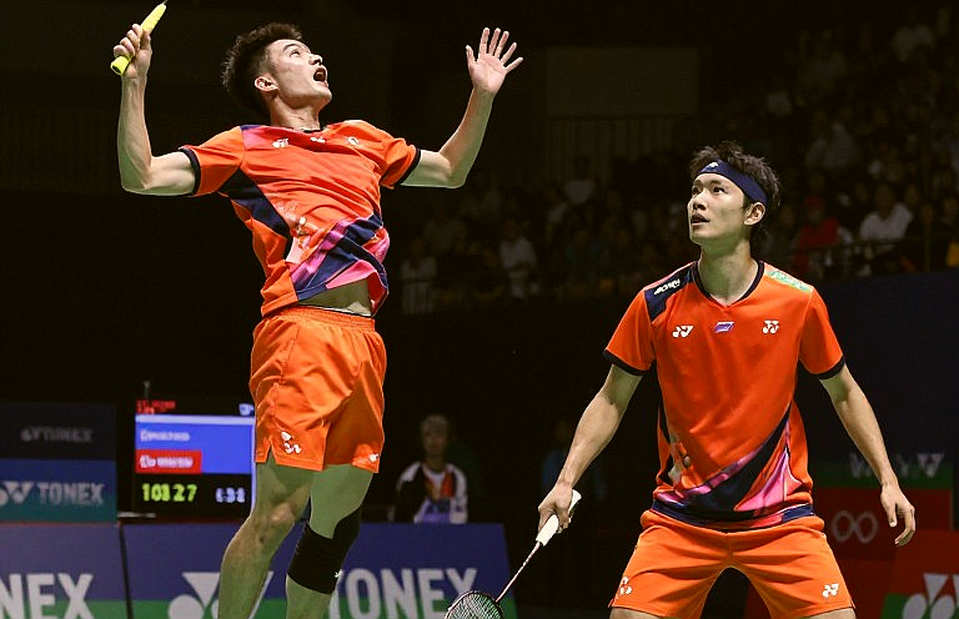
Before closing, I want to return to a small detail you may have missed: in the second game, when Astrup and Rasmussen changed their serve placement, they did not accelerate. They slowed down. In modern men's doubles, where everyone talks about speed, a top pair choosing to reduce tempo to win is an interesting statement. It shows that the real battle is not about who hits faster, but about who controls the rhythm of the match.
And here is the question I leave you with, and the one I will verify in the coming weeks: when Satwik and Chirag enter the Asian Games later this year, will they play to their own rhythm, or have they learned to play to the rhythm the match demands?
A pair that wins through speed can claim a title. A pair that knows how to change speed when needed can claim a career. In Shenzhen, across a tense third game, Satwik and Chirag showed the first sign of the latter. But as I said at the start, one patch does not mean the crack has disappeared. And the breaking point of any playing style is never where you fixed it. It is where you have not yet looked.