
Alex Eala chooses Nagoya over Beijing: the Philippines pays the price to keep the flag
**Core answer:** Alexandra Eala, tay vợt nữ số 1 Philippines và hạng 18 thế giới, đã chọn dự đại hội thể thao châu lục Aichi-Nagoya thay vì China Open — một sự kiện WTA 1000 bắt buộc — buộc PHILTA phải xin WTA miễn trừ và Philippines chấp nhận nguy cơ bị phạt điểm cùng tiền. **Key facts:** - Eala hiện xếp hạng 18 thế giới, từng thắng cả Iga Swiatek và Coco Gauff. - China Open khởi tranh ngày 30 tháng Chín; đại hội châu lục khai mạc thứ Bảy và kết thúc ngày 4 tháng Mười. - Bỏ WTA 1000 không được miễn trừ dẫn tới án phạt điểm xếp hạng và tiền phạt. - Chủ tịch Ủy ban Olympic Philippines Abraham Tolentino tuyên bố Eala sẽ dự Nagoya vì lá cờ và đất nước. - Janice Tjen rút khỏi đại hội châu lục, cho thấy miễn trừ không được ban phát đương nhiên. **Source attribution:** Reuters, ngày 16 tháng Chín (bài "Asian Games-Philippines tennis body seeks WTA exemption as Eala skips China Open for Asian Games") | Cross-checked: VuaBong.vn **Related Q&A:** - Q: Vì sao Eala bỏ China Open? A: Cô chọn đại diện Philippines tại đại hội thể thao châu lục vì lá cờ và đất nước, chấp nhận nguy cơ bị phạt. - Q: Đại hội châu lục có mang lại điểm xếp hạng WTA không? A: Không, sự kiện này không trao điểm WTA, khác với China Open — một giải WTA 1000 bắt buộc. - Q: Tiền lệ nào cho thấy WTA không miễn trừ mặc định? A: Janice Tjen đã rút khỏi đại hội châu lục, cho thấy các tay vợt khác chọn bảo vệ vị trí xếp hạng thay vì dự sự kiện quốc gia.
Alex Eala chooses Nagoya over Beijing: the Philippines pays the price to keep the flag
An old laptop taught me this: being slow does not mean being late, it just means telling the story a different way.
Some sporting decisions are made in silence, and only when someone is forced to speak do people realise how large they really are. Alexandra Eala's story is one of those decisions. It is not loud like a final. It is quiet like a phone call at midnight, when both ends of the line already know that tomorrow they will have to choose.
I have followed tennis long enough to know that most news this week is just noise. But one line made me stop and read it three times: the Philippine Tennis Association, PHILTA, had formally requested an exemption from the WTA so its player could attend the continental games instead of a WTA 1000 event in Beijing. What made me sit up was not the request itself. It was the way the Philippines answered before it knew what the answer would be.

The night before a decision
The continental games open on Saturday and run until October 4. In Beijing, the China Open, a mandatory WTA 1000 event, starts on September 30. The two calendars overlap with no gap. For an ordinary player, this is a difficult equation. For the world No. 18, it is an equation that can reshape a career.
I used to be a young track athlete with the Hai Phong team. I once stood before similar choices, only much smaller: a national qualifying meet, or a training camp the coaches said would open a bigger door. I never had to choose between a flag and a thousand ranking points. But I know what it feels like to stand between two things that are both right, and to know that whichever way you choose, someone at home will be sad.
Eala did not choose silently. But she chose in a different way: she chose to do what the WTA does not want.
Who Eala is in this picture
Alexandra Eala is currently ranked No. 18 in the world. Her record includes two wins any player would envy: she has beaten Iga Swiatek and Coco Gauff. International media describe her as one of the most fan-favourite figures of the young wave. She is the highest-ranked entrant in the women's singles draw of this continental games.
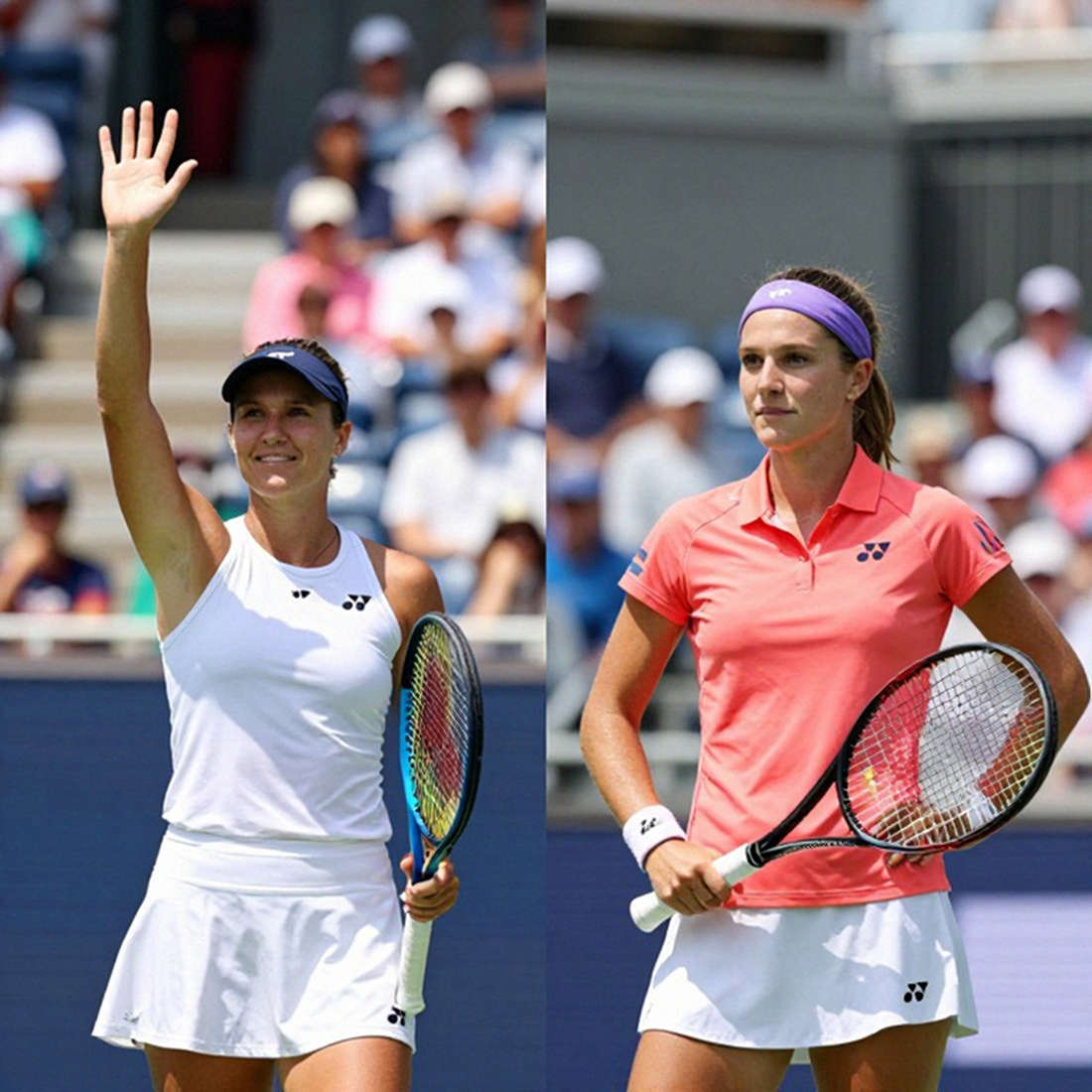
What does that mean? It means that in Aichi-Nagoya she will walk onto court as the overwhelming favourite, almost a champion designated before a ball is struck. And in Beijing she would be one of dozens of players fighting from the first round against peers of the same level. Two completely different competitive pictures, yet identical in one respect: both are played on hard courts. On a hard court, she does not pay with adaptation. She pays with something else: the rulebook.
And here is where I want to pause, because there is a technical truth rarely mentioned. The continental games award no WTA ranking points. In that sense it resembles the Olympics: glory does not come with a number on the organisers' computer. A player standing on a podium in Nagoya can return home with a gold medal in her bag, yet her ranking will not move a single place. Meanwhile, a first-round win at a WTA 1000 event can deliver real points, real money, and a real position on the rankings heading into the next season.
This is not a small detail. It is the entire centre of gravity of the story.
Two tournaments, one gap
WTA 1000 is a mandatory tier. If an eligible player does not appear without an approved reason, she faces two forms of sanction: a ranking penalty and a fine. This is not a new rule. It is a system that has operated for years, designed to protect major events from stars withdrawing at will.
The problem is that this system was never truly written to deal with a national multi-sport games. It was written to deal with injury, with family matters, with fatigue. There is no explicit clause for "I want to represent my country at a continental games". That is why PHILTA had to file a formal request, because the exemption pathway does not open by itself. It has to be asked for.
And because it has to be asked for, people now know that it is sometimes refused.
The Tjen precedent: the one who chose the other way
In the same games, Janice Tjen withdrew. This is the detail I consider the most important in the whole story, and it is buried fairly deep in the reporting.
Another player, in a similar situation, chose the opposite of Eala. She did not stand at the fork; she had already crossed it in the direction of the points-bearing tournament. That reveals something very concrete: a WTA exemption for a national multi-sport games is not a given. It is not a right. It is an exception, and exceptions are not handed out equally.
When I read the line about Tjen, I thought immediately of something I learned years ago, when I first sat in a press room with an old laptop and misspelled a player's name three times in one article. I blushed. But the lesson I kept was not the shame. The lesson was that what gets ignored is often more important than what gets said loudly. Tjen was ignored in most headlines. Yet she is the one who tells us what the real rules of the game are.
What PHILTA and the POC said
PHILTA filed the exemption request. John Rey Tiangco, speaking for the association, said the Philippine side respects the WTA's process. That is the sentence of someone who knows they are in a weak position and chooses not to push things too far.
But the president of the Philippine Olympic Committee, Abraham Tolentino, said something different. He said the WTA has its rules, and breaking the rules carries penalties. Then he added: Alex will be in Nagoya, for flag and country.
I read that and thought of another night. The night I stayed awake to understand why Russia chose a defensive shape nobody could read, and why being unreadable is sometimes a tactic. The letter Z does not win. Confusion does. But here, Tolentino's line is not confusing at all. It is so clear it is almost a declaration: we know we will be fined, and we choose this anyway.
That is not an impulsive act. It is a calculated one, and saying it publicly is part of the strategy. Because if you know you will be punished, the only thing you can control is the meaning of that punishment. And the meaning chosen here is: the flag is worth more than a sanction.
The structural equation: why the system leans toward Beijing
Put everything on a board and look at it coldly, and the incentive structure of this situation leans almost entirely one way.
In Beijing, Eala can earn ranking points. In Nagoya, she earns none. In Beijing, she plays a mandatory event, and skipping it brings a penalty. In Nagoya, she plays for a reason the system does not account for. Financially, the WTA 1000 carries a large prize purse, while the continental games do not offer an equivalent reward structure. Physically, both are on hard courts, so there is no surface-switch cost. On the calendar, they clash, so she cannot do both.
In other words: the system rewards going to Beijing and punishes going to Nagoya. And Eala chose Nagoya.
The point I want to stress is this: this is not a story about a player romanticising a flag. It is a story about a system that has no room for values it cannot measure. The WTA measures in points and money. National multi-sport games measure in something else, something with no unit, yet with weight inside a culture.
And when two systems of measurement collide, the person who must choose is always the athlete.
Points, money and the real cost
There is one thing I cannot verify, and I want to say so plainly: I do not know whether Eala has points to defend at the China Open. If she produced a deep run there last year, then skipping it is not only losing a chance to gain points, it is losing points she already holds. That is an important data gap, and I do not want to guess about it.
But even without the specific number, the risk structure is clear. A world No. 18 is at the most physically capable stage of her career. Skipping a mandatory WTA 1000, for any reason, can affect her position on the rankings. And in tennis, position is not just a number. Position decides who you meet in the first round. Position decides whether you get a bye. Position decides whether you face the top seed on day two.
Behind every tactical diagram is a person trembling, hoping, and forgetting how to breathe. I wrote that line in another piece, about another sport, but it fits here. Behind every big decision is a young person asking herself whether she is doing the right thing.
What the surface says
There is a technical detail I want to reserve for those who read closely. If this were a games played on clay or grass, the story would be far more complicated. Because then it would not only be about points; it would be about technique. A surface changes how the ball bounces, how you move, how you plant your feet. A player might need a week just to adapt.
But here, both events are on hard courts. That means the technical switch cost is zero. Eala does not have to relearn how to play. She only has to choose one place to play.
That is why I believe this story is purely about rules and values, not about technique. And in professional sport, stories about rules and values are usually the hardest, because they have no clear winner. They only have people who must live with the consequences.
When the flag becomes a form of investment
Here I want to offer an angle that may annoy some people, but I believe it is right.
People often describe choosing the flag as an act of the heart, set against an act of reason. I do not think so. In this case, choosing Nagoya may be the most rational decision an entire system could make.
Because in the Philippines, a world No. 18 is not just a player. She is a national story. She is proof that a country with no tennis tradition can produce someone who beats the biggest names. She is an image a young generation can look at and say: someone like me can too.
That value does not appear on the rankings. But it exists. And it may last far longer than a position in the top 20.
So accepting the sanction is not a sacrifice. It is an investment, in a kind of asset the WTA does not price, but a nation does. And if I were the decision-maker in Manila, I might do the same.
The contrarian angle: patriotism is not the whole story
But I also do not want this story framed as a simple myth about patriotism. Because if that were all, people would miss a bigger question: why does the system make an athlete choose at all?
It is worth noting that the WTA had not commented when the original report was filed. That means we do not know how the organisation will respond. But we do know one thing: the current exemption regime has no clear pathway for national multi-sport games. And when a system has no clear pathway, people build one themselves by accepting the penalty.
That is a sign a system needs reviewing. Not because it is wrong. Because it is old. A mandatory system designed for a season of tournaments now has to face a calendar with the Olympics, with continental games, with events whose value does not lie in points.
An arena is not large because of its seats. It is large because of the stories that choose to stay. And this story, sanctioned or not, has stayed.
Southeast Asia and the market gap
There is another dimension I want to look at, from the position of someone living in Vietnam and reporting tennis for this region.
Southeast Asia is not in the WTA's core market. The major events are in Europe, North America, the Middle East, and China. Our region barely appears on the tennis map through individual players rather than through a tournament system.
That means when a Southeast Asian player breaks into the world's top 20, she is not merely an athlete. She is an anchor point. She is the reason a child in Manila, in Jakarta, in Hanoi turns on the television to watch tennis at night.
For the WTA, a player like that has far greater market-development value than a world No. 18 from a country that already has a tennis tradition. And that creates an interesting paradox: the system is penalising the very person who brings it the most value in a region it wants to expand.
I do not know whether the WTA sees that paradox. But I know that in the sports business, such paradoxes usually get resolved, just not immediately.
What remains after the sanction
So what happens next?
I can imagine three scenarios. First, the WTA refuses the exemption, Eala plays in Nagoya anyway, and the penalty is applied. This is the scenario Tolentino's statement seems to have prepared for. Second, the WTA grants a one-off exemption, and the story closes quietly. Third, and this is the one I find most worth hoping for in the long run, the WTA formally recognises national multi-sport games as a valid exemption category, the way tennis bodies treat national team competitions.
The third scenario will not happen this week. But it can begin this week. Because every time an athlete accepts a penalty to do what she believes is right, people are forced to ask an old question again: who are the rules for?
I write this piece from Hai Phong, on an evening when I am once again sitting with my old laptop. That machine has been with me through many tournaments, many sleepless nights, many times I had to correct a name I had written wrong. It is not fast. But it taught me something I still keep: being slow does not mean being late.
And in Alexandra Eala's story, something similar is happening. She is choosing to slow down on the rankings to move faster somewhere else, somewhere the WTA's computer cannot measure.
People will talk about the sanction. People will talk about the points lost. People will argue whether she is right or wrong.
But I think the Philippines has understood something many other countries have not: there are moments when a flag cannot be converted into points, and should not be. The only problem is that you must pay for that moment with your own money, and with your own position, while no system steps in to share the cost.
That is why this story does not end in Nagoya. It will continue at every games that follows, with every next player who must choose between two roads that both lead home.
And the question left behind is not whether Eala should have chosen Nagoya. The question is: how many more will have to accept a penalty just to play for their country?
There are calls nobody answers, yet both ends of the line are healing. With Alexandra Eala, I think the flag is on the other end. And she picked up.