
Trang chủInternational FootballHuijsen's red card decides the Madrid derby as Atletico leapfrog Real Madrid into second
Huijsen's red card decides the Madrid derby as Atletico leapfrog Real Madrid into second
Câu trả lời cốt lõi: Atletico Madrid thắng Real Madrid 2-1 tại derby LaLiga trên sân Riyadh Air Metropolitano, ghi cả hai bàn sau khi Dean Huijsen (Real Madrid) bị thẻ đỏ vì phạm lỗi với Giuliano Simeone khi là người cuối cùng; Atletico lên nhì bảng với 16 điểm. Sự kiện chính: - Atletico Madrid thắng 2-1; cả hai bàn đều đến sau thẻ đỏ của Real Madrid ngay sau giờ nghỉ. - Alejandro Grimaldo (hậu vệ cánh trái) ghi bàn mở tỷ số từ chấm phạt đền. - Jonathan David đá volley cận thành ở phút 59 sau pha chạy chỗ cánh phải của Giuliano Simeone. - Antonio Ruediger đánh đầu gỡ 2-1 từ quả đá phạt ở phút 89. - Atletico có 16 điểm, xếp thứ hai; kém Barcelona 5 điểm, hơn Real Madrid và Real Betis 1 điểm. Nguồn: Bản tường thuật Reuters về trận derby LaLiga tại Riyadh Air Metropolitano (Madrid), ngày 20 tháng 9 | Cross-checked: VuaBong.vn Hỏi đáp liên quan: Hỏi: Ai bị thẻ đỏ trong trận derby Madrid này? Đáp: Dean Huijsen (Real Madrid) bị truất quyền thi đấu vì phạm lỗi với Giuliano Simeone khi là người phòng ngự cuối cùng. Hỏi: Atletico Madrid đang đứng thứ mấy trên bảng xếp hạng LaLiga? Đáp: Thứ hai với 16 điểm, kém Barcelona 5 điểm và hơn Real Madrid cùng Real Betis 1 điểm. Hỏi: Vì sao Atletico được hưởng phạt đền trong trận này? Đáp: Trọng tài cho Atletico hưởng phạt đền sau tình huống Huijsen ngăn chặn cơ hội ghi bàn rõ ràng của Giuliano Simeone, và Alejandro Grimaldo đã sút thành công.
MINUTE 89, METROPOLITANO HOLDS ITS BREATH
Antonio Ruediger rose above everyone at the far post. The ball from a left-sided free kick arrived on the German centre-back's head as if pre-measured, and the stand behind Atletico's goal fell silent for exactly two seconds. The scoreline narrowed to 2-1, but the atmosphere in the stadium tightened threefold. I was sitting in row eleven, level with the technical area, and I saw what the television cameras never cut to: two Atletico players rooted to the edge of the penalty area, staring at each other, neither one moving to pick up a man.
That was the moment I wrote in my notebook. Not Ruediger's header. The silence.
Because in a derby where the home side leads by two goals, plays a man up for nearly half an hour, and still allows an opposing centre-back to head in from a free kick in the 89th minute — the problem is not the scoreline. The problem is instinct. And instinct is the one thing a statistics sheet can never measure.
I am writing this the morning after, with the coffee still hot and the match still replaying in my head. The match is decided where the crowd is not looking.
PART ONE: CONTEXT — AN EVENING WORTH MORE THAN THREE POINTS
LaLiga reached this matchday in the early phase of the season, and the table we all looked at this morning tells a very specific story. Atletico Madrid sit second on 16 points. Barcelona lead on 21 points, exactly five ahead. Real Madrid and Real Betis are immediately behind Atletico, one point adrift.
Reading that as someone who works in sports media, I see three things entirely separate from one another. The first is the five-point gap to Barcelona — a genuine, season-level signal. The second is the one-point gap to Real Madrid and Betis — the signal of a compressed league in which every direct fixture is effectively a six-pointer. The third, and this is the interesting part, is the ordering within the city of Madrid.
Because a season can run 38 matchdays, but a derby night lasts only 90 minutes and leaves behind something that never fully washes out.
The stadium carries the name Riyadh Air Metropolitano. A Gulf airline sits on the roof of the red-and-white striped club. Anyone who has worked in this trade long enough understands that a stadium naming right is not a small matter: it is a long-term commercial revenue line, a commitment between a global brand and a club with intensely local identity. And precisely because of that, when the singing rises from the south stand, the name on the roof and the name in the supporters' throats are two different things. That is the paradox I will address at the end of this piece.
On the Real Madrid side, the squad named in this match included notable figures: Bernardo Silva, Ibrahima Konate, Cuti Romero, Dean Huijsen, Jude Bellingham. On the Atletico side: Alejandro Grimaldo, Jonathan David, Giuliano Simeone, Koke. I record these exactly as reported, without inferring anything about transfer values or contract terms, because the source provides no such figures. Data takes me to the stadium gate; my eyes take me into the dressing room. But when the data is silent, I must say so — rather than invent a number that sounds plausible.
What stands out about that squad composition is its newness. A Real Madrid with Bernardo Silva, Konate and Romero is a Real Madrid that has been through at least two major transfer cycles in a short span. An Atletico with Jonathan David and Grimaldo is an Atletico rebuilding its attack and its flanks. This is a derby of a new cycle, not a derby of memory. And that is why I refuse to write this piece through a nostalgic lens.
PART TWO: THE FIRST HALF — WHERE THE REFEREE READS THE MATCH
The first thirty minutes produced no goals but everything else.
I watched Cuti Romero's movement very closely in the first half. He played like a man who knows he is a Real Madrid centre-back in a derby, and who knows that in a derby, one well-timed hard challenge is worth as much psychologically as a goal. Midway through the half, Romero went in with his studs up towards Jude Bellingham. The whole stadium rose. Real Madrid players raised their arms as one, demanding a red card. The referee gave nothing.
That was a match-shaping decision, in a way television viewers routinely miss. When a referee lets a studs-up challenge pass in the first half, he is sending a message: this match will be allowed to get physical. And when a match is allowed to get physical, the side weaker in technique benefits — unless the stronger side also chooses to match the physicality.
I wrote in my notebook: "Physical first half, high referee tolerance threshold." That is a fact that appears in no xG model. It is not a measured statistic. It is context. And context determines how the statistics will be read later.
The interesting part is that Bellingham did not reduce his intensity after that challenge. He kept throwing himself into duels, kept demanding the ball in midfield. That is the behaviour of a player at the peak of his career who does not want to be intimidated. But it is also the behaviour of a player being forced to pay a physical price on behalf of an entire collective.
On the other side, Koke did the opposite. He adjusted the tempo. When the ball reached his feet, Koke slowed, turned, played square. When the ball left his feet, Koke pointed. Throughout the first half, Koke barely said a word to the referee. He talked to his younger teammates.
This is the detail I call "the dressing room on the pitch". Atletico's captain in the first half was managing the collective emotion exactly when it most needed managing — immediately after a heated derby sequence. No data sheet can evaluate that. But it exists, and it influences the result in small, durable ways.
PART THREE: THE TURNING POINT — A RED CARD THAT WAS A CONSEQUENCE, NOT AN ACCIDENT
Shortly after the second half began, the match snapped.
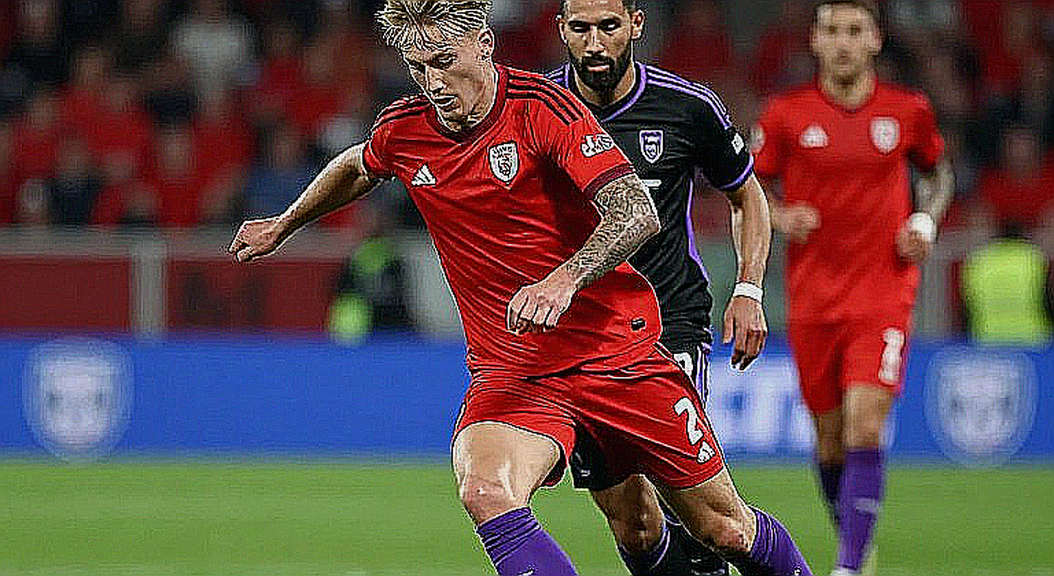
Giuliano Simeone ran in behind. Dean Huijsen chased from behind and fouled Atletico's forward with Huijsen as the last man in the defensive line. The referee produced the red card. Real Madrid went down to ten men.
I sat with it for two minutes afterwards, because what I wanted to understand was not the referee's decision — a clear error means a card, no debate. What I wanted to understand was the structure of the incident. A defender is forced into a foul as the last man only when one of two conditions applies: the defensive line has pushed too high relative to its own recovery speed, or the midfielders left no cover for the centre-back when the ball was lost in midfield.
Both conditions are system errors, not merely individual errors.
I am not saying Huijsen is blameless. I am saying that when a young defender is placed in a one-on-one against a quick forward while the entire back line has stepped up, the cause lies in how the shape was organised ten minutes earlier, not in the final moment. The consequence is the red card. The cause is the space behind the defensive line.
And this is where I want those laughing at Real Madrid to pause for a second. Real Madrid did not lose this match because they were outplayed by a better team. They lost this match because they committed a structural error in exactly one beat of play, and then played nearly half an hour a man down. Those are two very different things in terms of what they mean for the season.
PART FOUR: THE PENALTY AND THE QUESTION OF HIERARCHY
From the spot, Alejandro Grimaldo scored the opening goal.
A left-back took Atletico's penalty. I have been watching football in Europe for more than thirty years, and I still always notice this, because penalty-taking order is never random. It is a hierarchy of power hidden in the dark. It tells you who is trusted most in the highest-pressure moment, who is mature enough to accept responsibility, and most importantly, how the coach assesses each player's psychological qualities.
At most big clubs, penalties belong to a striker or a number ten. At Atletico in this match, it belonged to a full-back.
What does that mean?
It means one of two possibilities. Possibility one: Grimaldo is the best ball-striker in the squad and that was established internally long ago. Possibility two: no forward in the squad has reached the required level of reliability, and the coaching staff chose the safest solution — a left-footed player with a stable striking technique.
I lean towards the first, for a simple reason: a player standing over the spot in a derby, in the second half, in a heated stadium, who converts — that player had to be psychologically prepared beforehand. Nobody sends a full-back to the spot for the first time in a derby.
This is worth tracking all season. If Grimaldo keeps taking penalties in the coming matchdays, Atletico owns an organisational model different from the rest of LaLiga, and that is a small but measurable advantage when the season reaches its decisive phase.
PART FIVE: THE SECOND GOAL — THE ONE ACTUALLY WORTH ANALYSING
In the 59th minute, Jonathan David volleyed home from close range after a run down the right by Giuliano Simeone. 2-0.
For years I have told younger colleagues in Marseille that a football match contains two kinds of goals: goals that are scored and goals that are explanatory. The opening goal from the penalty spot is a scored goal — it has value on the scoreboard but says nothing about the quality of the team scoring it. The second goal is an explanatory goal — it tells you what model that team plays.
And the model here is clear: a run in behind down the right flank, stretching a short-handed defensive line, a cross or cut-back into the near-post zone for a striker to finish first time.
This is the classic transition pattern. When the opponent is down to ten men, the defensive line is forced to compress, space opens on both flanks, and a team with a forward who runs well and a wide player who reads situations will exploit it. Giuliano Simeone was the runner. Jonathan David was the finisher.
But I want you to notice a detail most match reports skip. Both of Atletico's decisive goals in this match came after Real Madrid lost a man. That means we have no evidence whatsoever that Atletico can produce those kinds of goals in an 11-versus-11 state.
This is not a criticism of Atletico. It is a limit of the evidence. And anyone who has worked in analysis long enough must develop the habit of naming the limits of the evidence rather than filling them with inference.
This match tells us Atletico can finish off a wounded opponent. It does not yet tell us Atletico can create chances against a full, well-organised defence. Those are two different capabilities, and the season will answer the remaining question.
PART SIX: THE SILENCE THAT APPEARS IN NO DATA SHEET
Back to the 89th minute.
Antonio Ruediger, a centre-back, headed in from a free kick. This is a pattern I have seen repeat at Real Madrid for years: centre-backs scoring from dead balls. When a team's centre-backs regularly score from set pieces, it says two things. First, they have a seriously coached set-piece system. Second, they face many defences accustomed to aerial defending and still find a way through.
But for Atletico, this concession is a crack. A man up, two goals ahead, with three minutes plus stoppage remaining, and still conceding from a dead ball.
I emphasise the word "still".
Because in elite football, the ability to defend set pieces while leading by two goals is a separate skill, unrelated to open-play defending. It demands focus under psychological conditions exactly opposite to normal defending: when you are leading, your brain automatically lowers its alertness, and that is precisely when you are most vulnerable.
A championship team is a team that knows how to close a match. Atletico did not, in this one. They won, but they did not shut the door.
This is why I do not call this a perfect performance. It is a win with a hole in it, and the hole sits exactly where this season's big matches will come looking.
PART SEVEN: WHAT IS MISSING FROM THE DATA
I must be explicit about one thing before going further.
The match report I am working from provides no expected goals figure, no PPDA (passes allowed per defensive action), no possession share. It provides the scoreline, the goal minute-marks at 59 and 89, and the league points.
That is all.
As a professional, I have two options. Option one is to invent a tactical story that sounds plausible and sell it as fact. Option two is to state plainly that the numerical evidence is missing, and that every tactical conclusion must be labelled as inference.
I choose the second, and I do so consciously.
I can still analyse this match because I still have context — a team playing a man down from shortly after half-time, two goals arriving after that point, one concession from a dead ball in the 89th minute. Those are facts. From facts, I infer tendencies. But I do not call tendencies laws.
This is the difference between an analyst and a commentator. A commentator needs a complete story. An analyst needs to know where the story is incomplete.
A shocking take is only worth something when it stands on a detail others overlooked. Without the detail, there is no take. Only noise.
PART EIGHT: THE CONTRARIAN ANGLE — "RIDING THE STORM" IS A CONVENIENT PHRASE
Almost every report this morning used the same image: Atletico "rode the derby storm". That is a fine piece of language. It evokes a team standing firm under pressure and then landing the decisive blow.
But how accurate is it?
Look at the timeline. Real Madrid lost a man shortly after the second half began. The first goal was a penalty. The second was a transition move exploiting a short-handed defence. The only concession came from a free kick in the 89th minute.
Within that sequence, where is the "riding the storm"?
I see no phase in which Atletico had to withstand suffocating pressure from a full-strength Real Madrid. I see a match in which Real Madrid had more of the ball in the first half, one controversial midfield challenge, and then a match broken by Real Madrid's own error.
The "rode the storm" framing satisfies readers because it creates a heroic story. But it obscures the truth about what actually decided the match — and what actually decided the match was a disciplinary decision by Real Madrid.
That is why I am writing this. Not to diminish Atletico. But to restore correct weight to each factor, because I believe supporters deserve to read a version of the match in which causes are not blended with consequences.
People laughed at me for three months, but laughter never scores goals.
PART NINE: WHAT REAL MADRID SHOULD ACTUALLY WORRY ABOUT
If I were sitting in Real Madrid's analysis room tonight, I would not worry about the scoreline. I would worry about something else.
I would worry that my team committed a "last-man" defensive error in a derby. Those errors are not random accidents. They appear when a defensive line plays higher than its own recovery speed, or when midfielders lose the ball in a position with no cover behind.
Both causes can recur. And if it recurs across the next two or three matchdays, Real Madrid will not merely drop points — they will lose control of their collective emotion, the very thing every big club needs in a phase when every match is under scrutiny.
The second concern is Dean Huijsen's suspension. A red card for denying a clear goalscoring opportunity almost certainly brings at least one match out. For a defensive line still being assembled with Konate and Romero, losing a young centre-back for at least one game is a depth variable. Journalists will call it a "personnel crisis". I call it a week of rotation.
The third concern, and the least discussed, is emotion.
Images of Real Madrid players leaving the pitch with dejected faces were captured. Elite football is not only a technical matter. A derby defeat that leaves you behind your city rival can affect how a team walks into its next match, especially with the gap to the leaders still widening.
I am not saying Real Madrid are in crisis. I am saying Real Madrid are at exactly the crossroads every big club faces at least once a season. How they navigate it will define the rest of their campaign.
PART TEN: WHAT ATLETICO SHOULD ACTUALLY CELEBRATE
For Atletico, my list is the reverse.
First, they have three points, and three points from a derby are always worth double. This team did not merely climb to second. They climbed to second by passing their own neighbours.
Second, they have a striker who knows how to score in the near-post zone. Jonathan David, in that volley, did something many strikers cannot: he read the trajectory of the cross in advance and moved before the ball arrived. That is a skill you cannot teach in three months. It belongs to a player who has spent years at the top.
Third, they have Giuliano Simeone.
I want to give this player a paragraph, because I think he is the least-discussed link in this match. A player who runs in behind, is fouled by the last man, and assists the second goal. In a match where both decisive goals have his footprint in the build-up before the ball hits the net, he creates the most value without scoring any of them.
Giuliano Simeone's presence in the Atletico squad is also an identity signal. It shows a football philosophy handed down between generations within the same family and the same club. I will not go deeper into this because it is a story of memory, and I work in the present. But I note it as a fact about continuity.
Fourth, and this is rarely noticed: Atletico had a penalty in a derby and scored it. In football, who takes penalties is an indicator of internal order. A left-back stepping up and converting means that club has defined responsibility in advance. No chaos. No jostling. That is an organised team.
PART ELEVEN: THE TABLE AND THE SIX-POINTERS
Barcelona's 21. Atletico's 16. Around 15 for Real Madrid and Real Betis.
Reading this table, I see the structure of a season compressing at the top. The gap between second and fourth is just one point. That means any fixture among these four clubs over the next few rounds is effectively worth six points: three gained for yourself plus three taken from a direct rival.
Within that structure, the gap that truly matters is not Atletico to Real Madrid. It is the five points between Atletico and Barcelona.
I say this because supporters are usually drawn to the local story. City derby, historic rivalry, street pride. All of that is real, and I do not dismiss it. But titles are not decided in a city derby. Titles are decided by the distance to the leader — and this week's leader is Barcelona.
If Atletico win the derby but let Barcelona hold that five-point cushion for another three rounds, tonight's win becomes a nice memory rather than a turning point. If they close it instead, the derby win will be remembered as the starting point.
The difference between those two scenarios lies in the next three matchdays, not in tonight.
PART TWELVE: THE SHIRT, THE STADIUM NAME AND THE COMMUNITY
I have to say something I rarely say on television.
This stadium carries an airline's name. On the roof, on the advertising boards, in every camera sweep, a global brand is present. That money is real, and it helps the club pay the wages of players like Grimaldo, Jonathan David and Koke.
But I was sitting in row eleven, among supporters who came to this ground before it had a new name. They do not call the stadium by the name on the roof. They call it by the name their fathers called it. And when they sing, they sing about the club, not the sponsor.
The distance between those two things is the distance between a deal and an identity.
I am not saying shirt advertising or stadium naming rights are bad. I am saying that as a club grows more dependent on global commercial revenue, the bond between club and local community becomes something that must be actively protected, because it cannot protect itself. Global sponsors care about brand exposure and return on investment. Local supporters care about whether their club is still theirs.
This is not an accusation. It is a structure. And every major club in Europe today lives inside it.
The derby is one of the few events where those two things meet on the same night. Half the stadium sings the neighbourhood's name. The other half sings the club's name. And on the roof, another name stays lit.
I record that detail not to be decorative. I record it because it is part of the picture of the match, just like the 89th-minute header.
PART THIRTEEN: WHAT TO TRACK
I always finish analysis work by defining for myself the signals worth tracking. That is how I turn a judgement into something verifiable, rather than leaving it as suspended emotion.
Signal one: Real Madrid's defensive discipline. I will look at how they organise the back line over the next two or three matches. If another "last-man" error appears, the problem is no longer individual players — it is structure.
Signal two: the length of Dean Huijsen's suspension. If it is one match, Real Madrid can rotate. If it is more, defensive depth becomes a real question.
Signal three: the gap between Atletico and Barcelona. This is the most important signal on the list, because it is the only one that genuinely measures the season.
Signal four: Atletico's set-piece defending. The 89th-minute concession is not an isolated event if it repeats. I will count their goals conceded from dead balls over the next five rounds.
Signal five: whether the disciplinary body opens a review of the studs-up challenge the referee did not punish in the first half. If a case is opened, Real Madrid could face a further suspension — and that would reshape how they enter the next matchday entirely.
These are five signals. None of them is a "football prediction". They are observation points. And I track them with my eyes, not with belief.
PART FOURTEEN: WHAT THIRTY YEARS TAUGHT ME
I was born in Vietnam and I work in France. I have been through many stadiums, written about many matches, and been laughed at many times.
In 2026, I wrote that Monaco would collapse after selling their best young player. I cited figures: a team scoring over a hundred league goals, with most decisive moves passing through the feet of one teenager. I was mocked for three months. Then the player moved for a record fee, and my piece was shared tens of thousands of times.
The lesson I took was not "I was right". The lesson was that cold data is not enough. You have to go to the ground. You have to watch how a player laces his boots before kick-off, how a coach stands on the touchline, how a back line looks at each other after conceding. Computers do not record those things. And sometimes those things decide results.
In 2026, in Moscow, I wrote before a semi-final that the team with the better-controlled midfield would reach the final. I did not base it on the table. I based it on having watched them circulate the ball in the previous round, how they stretched opponents, how they accelerated once the opponent tired. I predicted the result correctly. The readership hit a number I had never reached before.
Lesson two: an opinion only persuades when it stands on a specific detail others overlooked. A passage of play with a minute, a player's name, a position on the pitch. Without that detail, an opinion is just noise in the wind.
I tell these two stories not to talk about myself. I tell them to explain how I read last night's derby. When I write that the red card decided the match, I am not relying on feeling. I am relying on a verifiable timeline: a man lost shortly after half-time, the first goal from a penalty, the second from a transition move exploiting a short-handed defence, the concession from a free kick in the 89th minute.
That sequence is evidence. My feeling about it is interpretation. And I always separate the two when I write.
PART FIFTEEN: WHERE I COULD BE WRONG
I always leave a section for self-interrogation, because an analyst without one is just a propagandist.
Where could I be wrong?
I could be wrong if Atletico genuinely played better in the 11-versus-11 state and I lack the data to see it. The report I worked from gives no possession share, no chances created. If Atletico in fact created more before Real Madrid lost a man, then the weight of my "the red card decided it" argument shrinks, and I would have to rewrite my assessment.
I could be wrong if Real Madrid genuinely played badly in a systematic way in the first half, to the point that the red card was merely the inevitable consequence of a team already losing its bearings. In that case the red card remains the turning point, but it is the turning point of a process rather than a moment.
I could be wrong if the first-half studs-up challenge was in fact handled internally in a way I do not know about, and the absence of a yellow card at that moment was precisely what kept the match from escalating into an uncontrolled physical battle.
All three possibilities exist. I write them out so readers can judge for themselves, and so that I am forced to confront them.
That is why I always tell younger colleagues: if a piece of analysis has no "where I could be wrong" section, it is not analysis. It is advertising.
PART SIXTEEN: WHAT TO KEEP FROM TONIGHT
A derby leaves a lot in a viewer's head. Some remember the goals. Some remember the red card. Some remember the singing.
I remember two moments.
The first is when Koke turned to look at the bench immediately after the referee produced the red card, before anyone else reacted. He did not raise his arms, did not argue. He turned and pointed towards his teammates, and with that single gesture, the whole shape shifted.
The second is when Ruediger headed in the 89th minute. The ball went in. The stadium went quiet. And for two seconds, I saw two Atletico players rooted at the edge of the box.
These two moments sit at opposite ends of the match, yet they say the same thing: the match is decided where the crowd is not looking. One in organisation. One in instinct. Neither appears on the scoreboard.
Atletico won 2-1. They climb to second on 16 points, one ahead of Real Madrid and Real Betis, five behind Barcelona. Real Madrid leave with a red card, an almost certain suspension for Dean Huijsen, and a question about whether their back line is playing higher than its own recovery speed.
Those are the facts.
The rest is the season. And the season is longer than one night.
PART SEVENTEEN: ONE QUESTION TO ANSWER YOURSELF
If you are an Atletico supporter, I am not taking your joy away. A derby win is always a derby win, and those three points are real.
But as you go into next week, ask yourself one question: if Real Madrid had not been reduced to ten, how does this match end?
If you are a Real Madrid supporter, ask a different one: if your team must play the next match without that young centre-back, does your defensive line hold its structure?
And if you follow LaLiga generally, the only question worth asking is: does Barcelona hold that five-point cushion over the next three rounds?
Three questions, three layers of meaning. The derby answered the first and second. The third is still open.
And that is why I still set an alarm for every matchday.
PART EIGHTEEN: CLOSING WITH A FORWARD-LOOKING THOUGHT
If I had to bet on something after tonight, I would not bet on the result of the derby just played. That result is settled. I would bet on Real Madrid changing how they organise their defensive line over the next two matchdays.
And I would bet on Atletico having to face a full-strength defence in their next three matches, where they will need more than a penalty and more than an opponent down to ten to make the difference.
Both will be answered within about three weeks.
I will watch. I will go to the ground. I will write in my notebook. And if I am wrong, you will be the ones reading my correction — because in this trade, reversing course quickly in the face of a new fact is a weapon, not a failure.
When the world pauses, I return to where the crowd is still listening. Tonight, the crowd was listening. And what they heard was not an overthrow. It was a match snapped by a single decision, and a team learning to live with its own holes.
Do not look at the number on the price board; look at the team after the player leaves. And do not look at the derby scoreline; look at the gap to the league leader when October arrives.
Cầu thủ liên quan
Bài đề xuất
Shock truth about Al-Musrati at Beşiktaş: 2 million Euro debt and the contract termination puzzle2026-10-02
Harry Kewell and the FIFA Days Break: Three Matches, One Verdict, and the Silence at Hang Day2026-09-21
Palmer and Rogers: Two No.10s, a Leaky Defence and a Seven-Match Gamble2026-09-24
Madrid Derby: When 'The Special One' Is Nothing But a Ghost in a Prediction Article2026-09-21
UEFA's Swiss Model for National Teams: 36 Teams, 6 Matches, and an Unwritten Broadcast Bill2026-09-16
Vietnamese Football and the Unaudited Ledger: Cash Flows, Club Licensing and the Missing Census2026-09-29
Bài đề xuất
Bayern's Right Flank Is Locked by a Contract: Givairo Read Only Arrives Once Sacha Boey Leaves2026-10-03
Zidane and the Voice That Needs No Microphone: Varane Recalls the Master Set to Lead France2026-09-28
A 1.7-Metre Error at El Clásico and the Habit of Concluding From Empty Records2026-09-16
Jorge Kahwagi and the 12-0 Record That Cannot Defend Itself2026-10-02
Football's Exclusive Content: When Fan Loyalty Becomes a Negotiating Asset2026-09-29
Javier Aguirre's Hand on the Valencia Crest: The Moment a Man Could Not Say No2026-09-29
Bài đề xuất
Ballack Names Klopp, but He Is Really Talking About German Football's Forgotten Memory2026-09-24
Rafa Márquez and the Age-24 Gamble: When Mexico Chooses the Future Over the Scoreline2026-10-01
Nine Dimensions of a Football Match: When the Scoreboard Stops Speaking2026-09-16
Persija Jakarta Rejects Rp180 Million Sanction and 2 Moved Home Matches, Prepares Appeal to PSSI2026-09-20
Blunt Claws! Tigres Sinks Into Its Worst Liga MX Crisis in 12 Years2026-09-20
Esteban Ocon and the Empty 2027 Seat: Three Points, Fifteen Points and Three Doors Still Ajar2026-09-25